


Dumpster Enclosures
Commercial fencing · St. Louis & St. Charles County
Dumpster Enclosures Built for a Working Lot
Code-compliant trash enclosures with steel-framed gates that still close in year five. Same crew that builds our fences, no subcontractors.
Get a quote Call or text 314-440-8873Why you’re probably here
Most people calling us about a dumpster enclosure are calling for one of three reasons: the city cited you, a tenant or a neighbor complained, or you are building new and the plan reviewer flagged your trash area. The fourth reason is the one we see most on the ground: the old enclosure has been patched four times, the posts are loose, the boards are pulling off the frame, and the gates hang off one hinge.
Whichever one it is, the fix is the same — screening that meets your municipality’s code, and gates that still work in five years. That second part is where most enclosures fail.
What a dumpster enclosure costs
Every enclosure is priced to the site, but here is what we actually quoted on a recent commercial job in Wentzville: a single 8-yard container, about 30 feet of 6-foot wall on three sides and a pair of 12′-10″ swing gates across the front, old enclosure torn out and hauled away.
Wood-on-steel, cedar-framed gates
$12,700 complete
6×6 gate posts in belled concrete piers, 4×4 wall posts, pressure-treated shadow box screening on both faces, two gate leaves on powder-coated steel gate frames with cedar rails and an adjustable anti-sag cable, drop rods into the concrete, plans, permit and inspections.
Welded galvanized gate frame
$16,300 complete
Same enclosure, with the gates built on a Hoover Fence welded 2-inch galvanized steel frame and a commercial padlockable flip latch. This is the one for lots where the hauler and the trucks are hard on the gates.
Those are all-in numbers — demolition, disposal, materials, labor, plans, permits, project management and cleanup. Enclosures for two or three containers, masonry enclosures, and enclosures that have to match the building are priced on site. Need the fence beside it replaced too? We already have the plans, permit and crew on site, so the combined price drops.
What your city actually requires
There is no single St. Louis-area standard. Requirements are set municipality by municipality, and they vary on height, materials, setbacks, and whether the enclosure has to be finished to match your building. What is consistent across most jurisdictions:
- The container has to be fully screened from the street and from adjoining properties
- Screening is commonly six feet — tall enough to hide a standard front-load bin
- Solid screening. Many municipalities will not accept open chain link on its own
- Gates that stay closed when nobody is servicing the container
- Some cities require the enclosure to be finished to match the primary building
How we build it
- Demolition — complete tear-out and haul-away of the old walls, gates, posts and hardware, dumpster and disposal included.
- Gate posts — two 6×6 pressure-treated posts, 12-inch holes 36 inches deep with a 16-inch bell at the bottom. Asphalt or concrete is cored with a 12-inch bit for a clean opening.
- Wall posts — 4×4 pressure-treated posts in 12-inch concrete piers 30 inches deep.
- Walls — 6-foot shadow box on all three sides: three rows of 2×4 rails, 5/8″ x 5-1/2″ dog-ear pickets on both faces, staggered so it looks finished from inside and out.
- Gates — each leaf on a powder-coated steel gate frame with cedar S4S rails and an adjustable anti-sag truss cable. Pickets on the outside face only so the hardware stays reachable.
- Hinges — heavy-duty hinges fastened with structural screws and through-bolted to the 6×6 so they never sag or walk.
- Drop rods — each leaf drops a rod into a hole drilled in the concrete to hold it open for the hauler and closed the rest of the time. A latch holds the pair together. Your signs go back up on the new gates.
- Fasteners — GRK structural screws on the rails, coated exterior screws on every picket, carriage bolts at hinges, latch and drop rods. No nails.
- Plans & permits — drawings, permit submission and all required inspections handled by us.
- Cleanup — daily cleanup, a magnet sweep for nails and screws, full cleanup at completion.
Why the gates are built on steel, and framed in cedar
A fence wall is held in line by its posts at both ends. A gate leaf hangs from one side and the other end is held by nothing, so any movement in the wood shows up as a leaf that racks out of square, drags on the concrete, or won’t latch. Pressure-treated lumber comes from the treating plant soaked, and as it dries it twists and bows — in a gate that movement has nowhere to go but out of square. So we frame the gates in cedar S4S, set the rails in a powder-coated steel frame that holds the corners square, and run a turnbuckle cable corner to corner. If a leaf ever starts to drop, we tighten the cable and pull it back up. No rebuilding the gate.
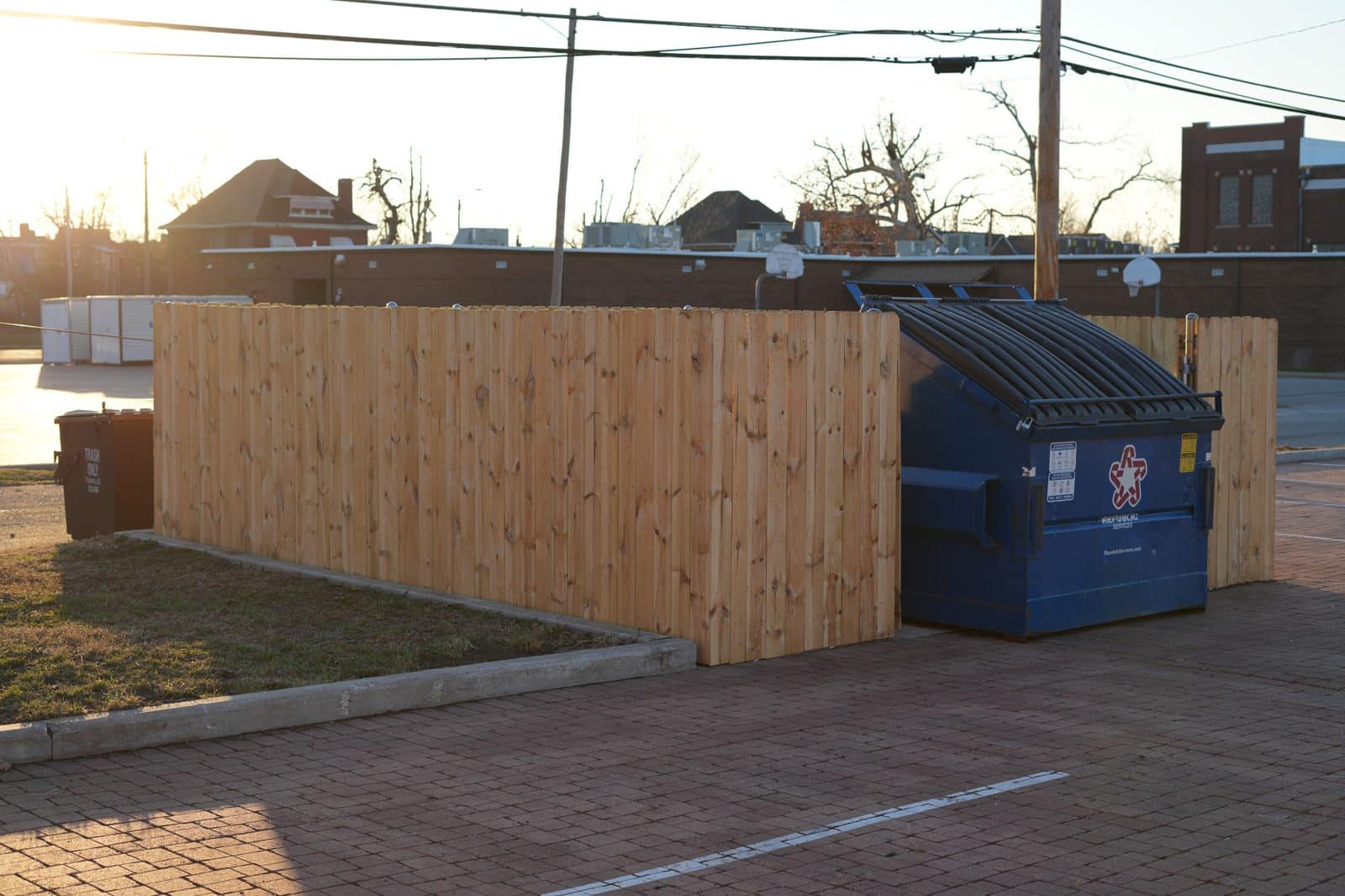
A cedar enclosure we built in St. Louis. Screening on both faces, steel-framed gates.
Other enclosure types we build
Masonry and CMU — required in some jurisdictions and specified on most new commercial construction. Heavier, more permanent, more expensive to repair when it gets hit. Chain link with privacy slats — where the code allows it, usually industrial zoning and back-of-house locations. The fastest and least expensive option. Steel-framed gates on any of the above.
Who we build for
Property managers, restaurants, retail centers, churches, apartment communities and general contractors on new commercial work across St. Louis and St. Charles County. One project manager from contract to walkthrough, written phased payments, permits and inspections handled by us, and a signed final lien waiver in your closeout packet. Dig-Rite is called before a shovel goes in the ground on every job.
Get your enclosure quoted
Send us the address, the container size, and a photo of the spot. One of the project estimators (Ryan or Nick) will call you within 24-48 hours from 314-440-8873.
Maniaci Construction Inc. · 11485 Dorsett Road, Suite E, Maryland Heights, MO 63043 · 314-440-8873