Deck Lighting
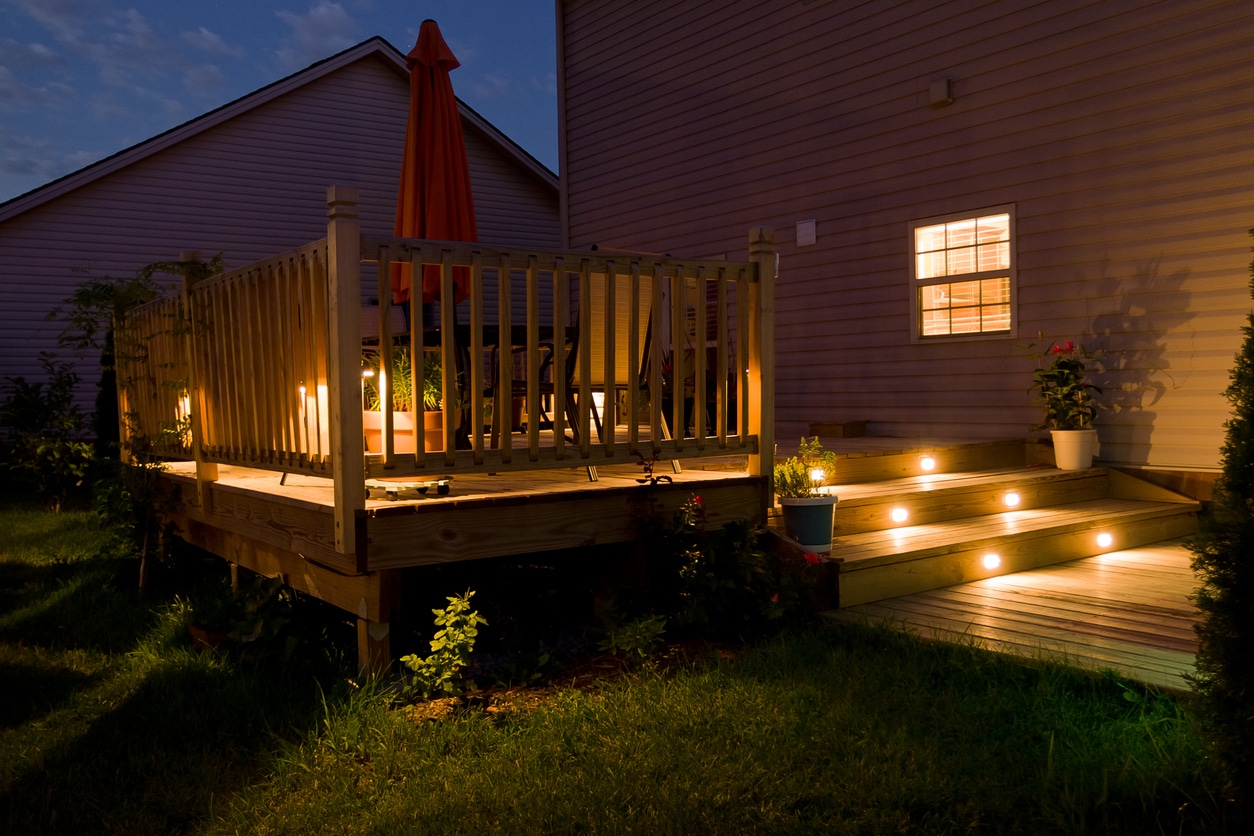
Lighting is the difference between a deck you use until dark and a deck you use after it. It is also far cheaper to do while the deck is being built than after — most of it hides inside framing, posts, and stair risers that are open exactly once.
Two ways to light a deck
Low-voltage wired, or solar. They are not really competitors. Plenty of our jobs use both.
| Wired low-voltage | Solar post caps | |
|---|---|---|
| Light output | Real, usable light | A soft glow that outlines the deck |
| Wiring | Planned and run during the build | None at all |
| Cost | Starting at $4,750 for a ten-fixture package | $110 per cap as a build upgrade |
| Consistency | Same every night | Depends on how much sun the cap gets |
| Best for | Stairs, in-deck perimeter, under-rail | Post tops, accent, and retrofits |
| Add it later? | Difficult once decking is down | Any time, in about a minute per post |
The TimberTech lighting system
Runs on 12 volts, backed by a 5-year limited product warranty, and everything below runs off one power pack.
We build with TimberTech, and their lighting is made to integrate with their railing and decking rather than be bolted on afterward. Here is the current lineup.
Composite rail lighting
| Fixture | What it does & finishes |
|---|---|
| Under-Rail Light | A hidden glow between balusters. Architectural Bronze. |
| Accent Light | For composite and PVC posts. Gloss White, Matte White, Architectural Bronze. |
| Post Cap Light | For Impression Rail Express. Matte White, Matte Black, Matte Espresso. |
| Lighted Island Cap | For 5.5” composite post sleeves. Gloss White, Matte White, Matte Black, Matte Espresso. |
| Reversible LED Accent Light | For Impression Rail Express. Matte White, Matte Black, Matte Espresso. |
| LED Lantern Post Cap Light | Fits 4” and 5.5” post sleeves. Matte White, Matte Black, Matte Espresso. |
Impression Rail Express lighting
| Fixture | What it does & finishes |
|---|---|
| Indirect Light Post Cap | Light thrown down and out rather than at you. Black, White, Dark Bronze. |
| Perimeter Light Post Cap | Outlines the rail line. Black, White, Dark Bronze. |
| Small Accent Light | Surface mounted. Black, White, Dark Bronze. |
| 3” Post Cap Light | Modern profile for Impression Rail Express posts. |
| LED Lantern Post Cap Light | Lantern styling. White, Black, Dark Bronze. |
Integrated deck lighting
| Fixture | What it does & finishes |
|---|---|
| In-Deck Light | A subtle, space-defining touch around the perimeter. Architectural Bronze. |
| Riser Light | Stair visibility — the one we push hardest, because it is a safety item. 6” × 1” × 3-1/8”. White, Architectural Bronze. |
| Recessed LED Riser | Discreet stair lighting. Matte White, Matte Black, Matte Espresso. |
| Power Pack 150W with remote | Powers the system. One of these runs the whole deck. |
What a wired lighting package costs
Nobody publishes this number, which is exactly why we will.
Wired low-voltage lighting is priced as a system, not per fixture. The transformer, the wire, and the labor to fish it through framing and railing posts are most of the job — the fixtures themselves are the smaller half. That is why a package price tells you more than a per-light price does, and why a small package is never proportionally cheaper.
Here is a real one, so you have something concrete to compare against.
- Six lighted post caps — TimberTech 4” × 4” LED modules, wired into the posts
- Four LED stair riser lights — recessed into the risers, nothing sticking out
- 150W transformer with a dimmer — sized with room to add more later
- All wire, connectors, and runs — concealed inside the framing, nothing visible
- Full installation and testing — we set the dimmer level with you after dark
Six caps lights the corners and both stair posts on a typical deck, or the full post line on a smaller one. Four risers covers a stair run of about four steps — a deck sitting roughly two and a half to three feet off the ground. If your deck is bigger than that, or has more than one stair run, we price it off the plan rather than making you buy a package that does not fit it.
What moves that number
- Whether we are already building the deck. This is the single biggest factor. Wire run before the decking goes down is straightforward. The same wire fished into a finished deck is a different job entirely.
- Railing type. Getting wire up through a post and out to a cap is where the hours go. Some railing systems are built for it. Others are not, and you feel the difference in the labor line.
- Run length. Long runs mean heavier wire, sometimes a second home run, and often a larger transformer — for reasons that have nothing to do with how many lights you have.
- Fixture count. Per-fixture time drops as the count goes up. Twenty lights does not cost twice what ten does.
- Smaller is not cheaper per light. Four post caps still needs the same transformer and the same wire run as ten. That is why we quote packages rather than publishing a per-light price that would be misleading at both ends.
Sizing the transformer, and why we oversize it
Low-voltage transformers follow the same rule as any other electrical circuit: you never load one past 80% of its rating. A 150W power pack has 120W you can actually use, and the last 20% is headroom, not capacity.
The math on the package above
Each post cap module draws 4W. Each stair riser light draws 2W. Six caps and four risers is 32W total — roughly a quarter of what a 150W pack will safely carry.
So why not spec a smaller, cheaper transformer? Because the transformer is the one component you cannot upgrade cheaply later. Adding six more post caps in year three is an afternoon of work if the pack has room for them. If it does not, you are buying a new transformer, pulling a new home run, and paying for access into a deck that is already finished. The headroom costs a little now and saves a lot later, and we would rather size it for the deck you will have in five years than the one we are wiring this week.
The limit you will actually hit first is voltage drop, not wattage. Twelve volts does not travel far before the wire itself starts eating it. Put a fixture at the end of a long run on undersized wire and it will visibly dim compared to the one nearest the transformer. The fixes are heavier-gauge wire, a multi-tap transformer, or splitting the deck into two shorter runs — and on a large deck that is usually what pushes you into a bigger power pack, long before the total wattage ever would.
Worth asking any contractor. What size transformer are you specifying, and what percentage of it will my lights actually use? If the answer is at or near 100%, the system is already full on the day it is installed, and every future addition is an expensive one.
The affordable option: solar post caps
Not every deck needs a wired system. For a lot of jobs, solar post caps get you most of the look for a fraction of the cost and need no wiring at all. These are the two we actually use — both made in the USA, vinyl body with acrylic lenses, and a 5-year warranty.
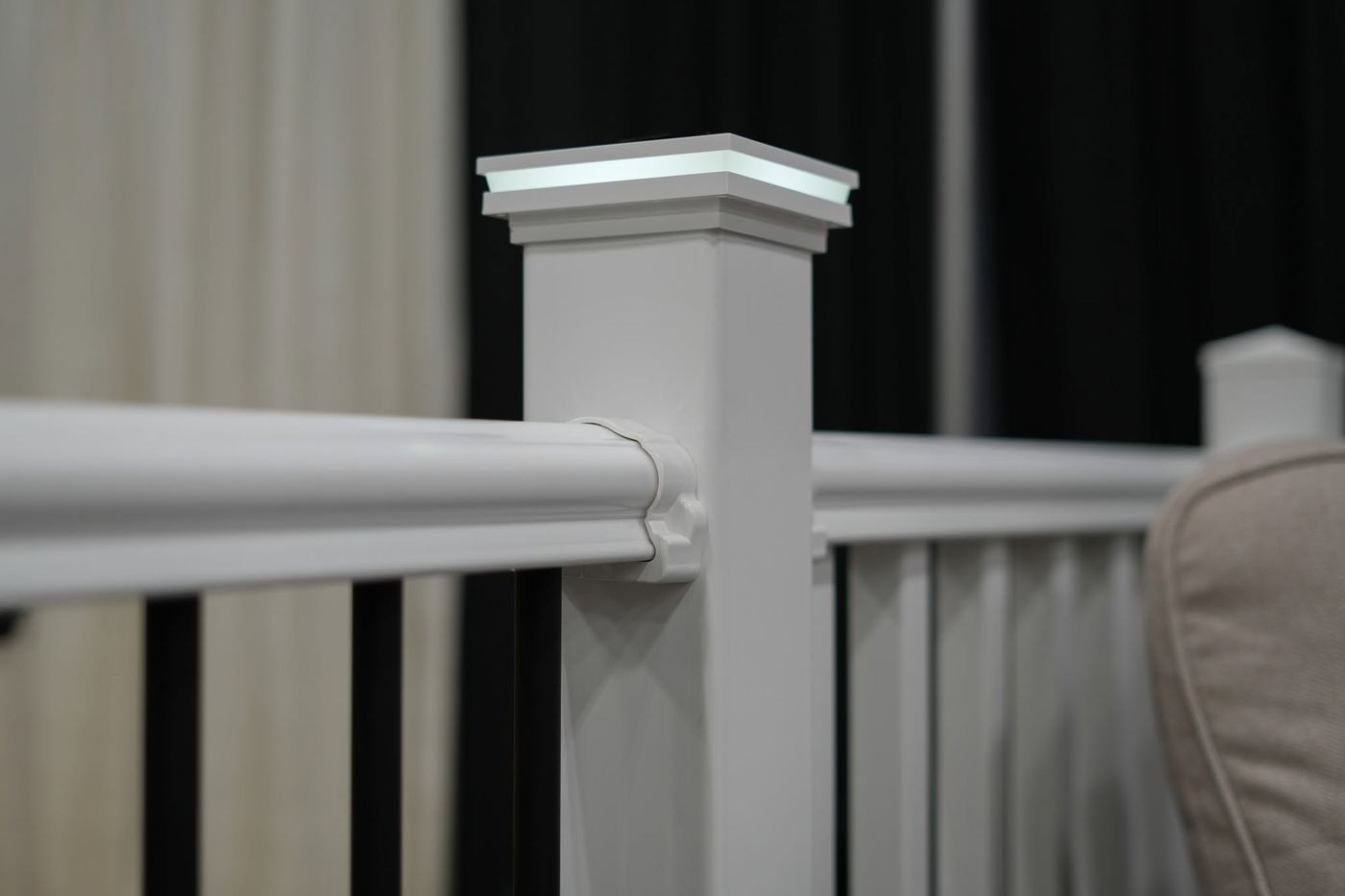
4” × 4” Ornamental Solar Post Cap — White
For Veranda white vinyl posts
- Fits 4” square posts
- 5000K cool white LED
- Vinyl body, acrylic lenses — 5-year warranty
- $110 per cap as a build upgrade
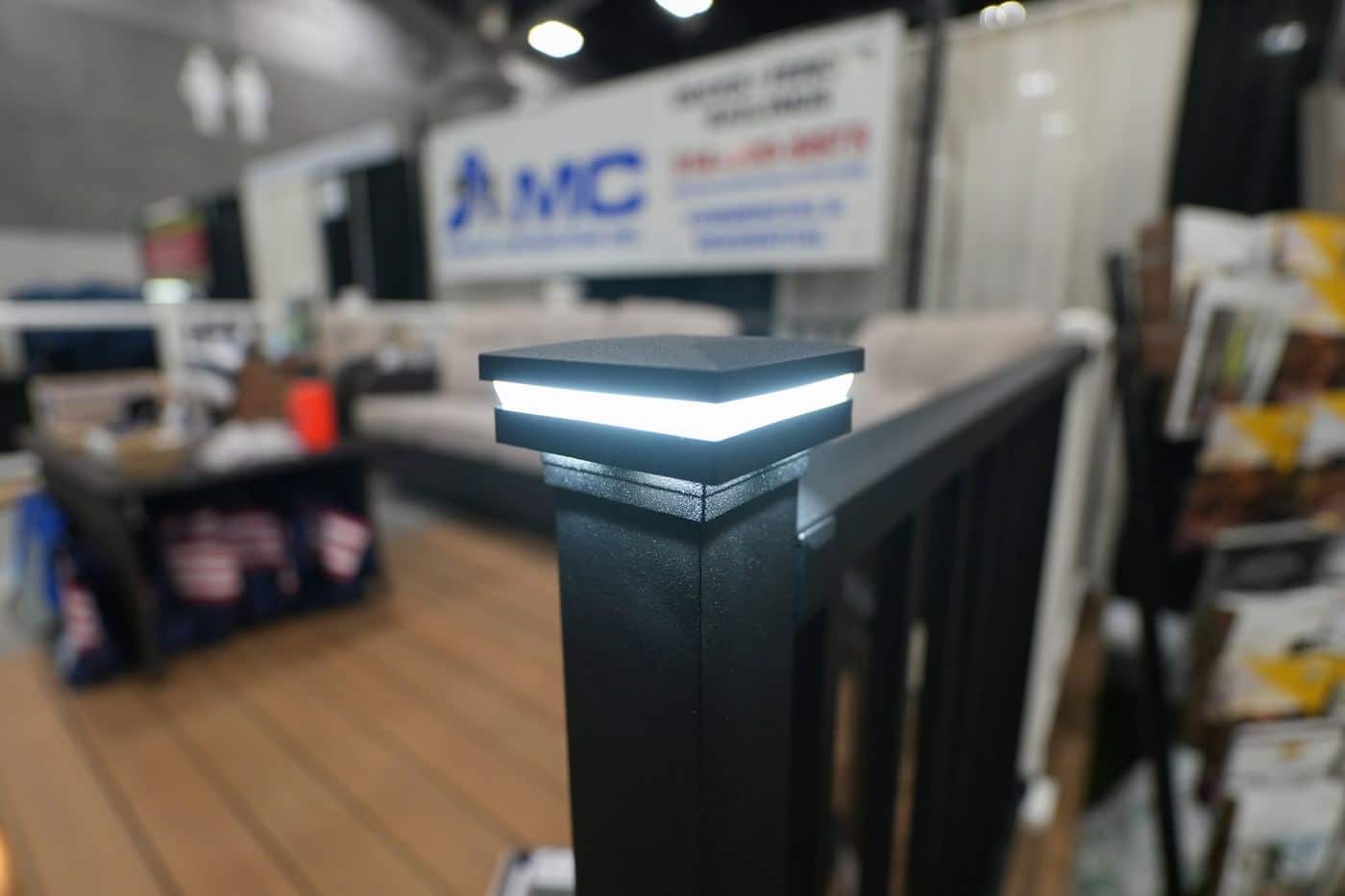
2” × 2” Ornamental Solar Post Cap — Black
For Westbury Tuscany aluminum railing
- Fits 2” square posts
- 5000K cool white LED
- Vinyl body, acrylic lenses — 5-year warranty
- $105 per cap as a build upgrade
Be realistic about what solar caps do. These are rated at three lumens apiece. That is a soft glow that outlines your railing after dark and helps you find the top of the stairs — it is not going to light a card game, and no solar cap on the market will. If you want light you can actually read by, you want the wired system. A lot of our customers run both: wired riser lights on the stairs where it matters for safety, solar caps along the rail for the look.
Plan it before we frame
This is the part worth getting right, because it is the cheap moment.
- Wired runs get pulled before the decking goes down. After that, every added fixture means lifting boards.
- Riser lights need the stair stringers detailed for them while they are being cut.
- The transformer needs a home and a GFCI outlet to plug into. Worth deciding early with your electrician.
- Solar caps are the exception — those can go on any time, which is exactly why they are a good answer for a deck that is already built.
Tell us how you actually use the deck after dark
Whether you need stair lighting, rail lighting, or just enough glow to see the edge, we will lay out the fixtures and the wiring on the plan before we frame — and tell you honestly where solar will do the job for less.
