



Wooden Decking
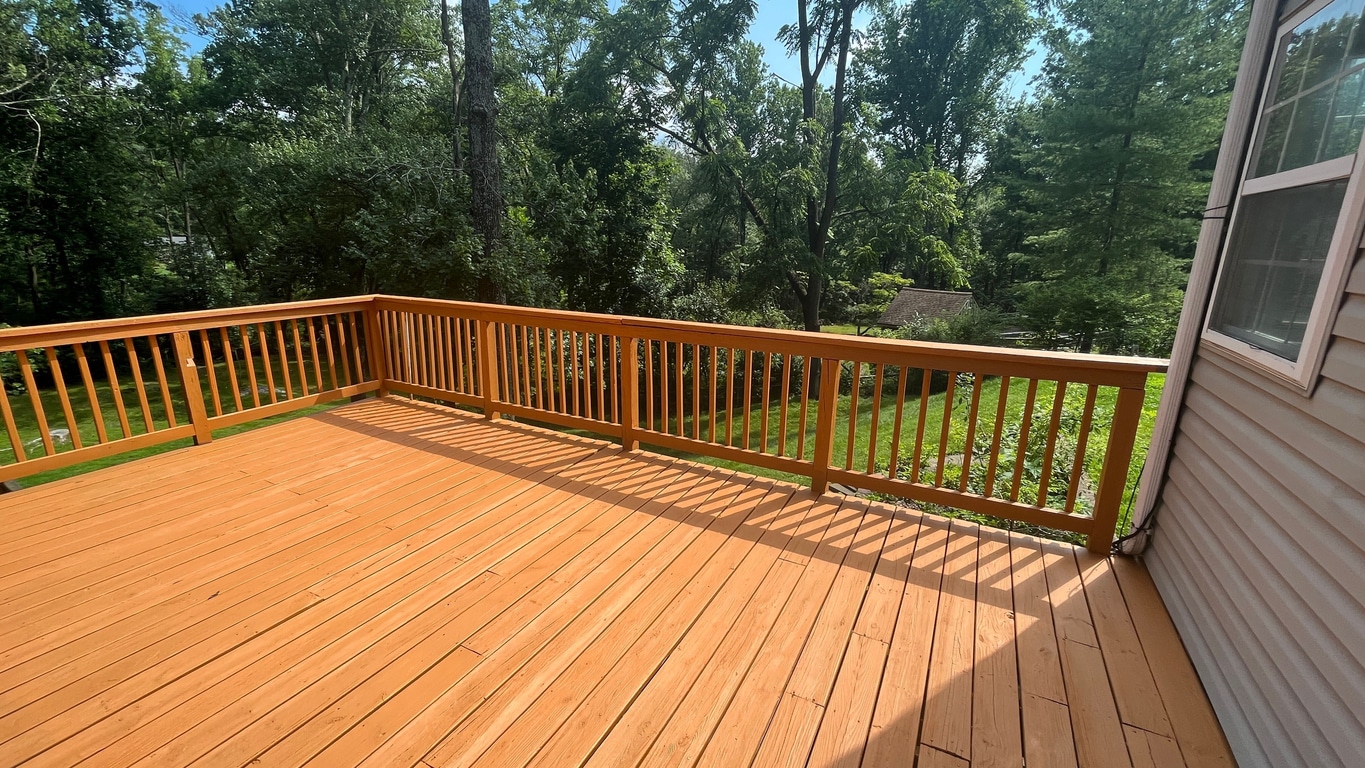
A wood deck is still the best-looking deck money can buy, and it is the one that asks the most of you afterward. We build in pressure-treated pine, cedar, and hardwood. The useful part of this page is what each one actually costs you once it is built.
Pressure-treated or cedar
This is the real decision, and it almost always gets framed as cedar being the better wood. That is not wrong, but it is not the useful way to look at it either. What matters is what the two share — because that is the part nobody tells you — and then what the extra money actually buys.
What cedar gives you
Cedar resists rot naturally. That resistance is in the wood itself rather than forced into it at a treatment plant. It has a warmer, more varied grain than treated pine, it moves less with the seasons, and it smells like cedar. It also costs meaningfully more, and it is softer — which matters more than most people realize once carpenter bees find it.
It ages two ways, and you pick
Left alone, cedar weathers to a silvery gray. Plenty of people want exactly that, and it is a legitimate choice — that is not the wood failing, it is cedar doing what cedar does. If you want to hold the original warm tone instead, it has to be sealed and re-coated on a schedule. Decide which one you want before we build, because it changes what we recommend for maintenance and what you should budget in year three.
What the extra money buys
Here is the comparison laid out honestly, including the parts that do not favor cedar.
Pressure-treated pine only
- Lowest up-front cost
- Rot resistance is chemical, not natural
- Uniform, greenish tone when new
- Cups and checks more
- Rarely gets carpenter bee damage
Both
- Real wood underfoot
- Grays out if left unsealed
- Takes stain
- Board-by-board repairs
- Cheaper than composite
Cedar only
- Naturally rot-resistant
- Warm, varied grain
- Aromatic
- More dimensionally stable
- Costs more
- Carpenter bees target it
Before you commit to cedar, read our page on carpenter bees and carpenter ants. Cedar is soft and usually left bare, which makes it the wood carpenter bees go after. We rarely see bee damage on pressure-treated framing and we see it on cedar regularly. It is not a reason to avoid cedar — it is a reason to finish it correctly and know what to look for.
How we build it
The finish is what you see. The framing is what decides whether the deck is still solid in twenty years.
The details that actually decide how long it lasts
Wood fails where water sits. So we keep framing out of ground contact, we flash the ledger, we tape the joist tops.
Fasteners and framing
Cedar gets stainless. Pressure-treated gets fasteners rated for treated lumber, because modern treatment chemistry is hard on cheap fasteners — and stainless is available there as an upgrade if you want it. Joists at 16” on center, which is what wood decking is built on. The tighter 12” spacing gets quoted a lot, but that is a composite requirement — on a wood deck it is lumber you are paying for and will never feel. Rail posts blocked and bolted, not lag-screwed to a rim and hoped for.
Permits and inspections
We pull them and we meet the inspector. You do not chase paperwork, and you end up with a deck that is on record as permitted — which matters the day you sell the house.
What upkeep really looks like
A wood deck needs cleaning and re-coating on a schedule, and how often depends on which wood and which finish. Done on time, a well-built wood deck runs well past twenty years. Skipped for a few seasons, the finish goes first and the boards follow.
Cedar around a pool. We will build it, and cedar is the wood we would use there — but it is not what we recommend. Bare feet and softwood are a rough combination, and constant splash-out keeps the boards from ever really drying, so the upkeep never lets up. Most people end up happier with composite or PVC in that spot. Our pool decks page lays out the full comparison, including how we build it if you want the wood.
Let’s talk about your deck
Tell us what you have in mind and we will walk the space with you, price the wood options side by side, and tell you honestly where the extra money is worth it.