



Pool Decking
A pool deck has to do things a normal deck never does. It gets walked on barefoot, it gets walked on wet, and it sits in constant splash-out and sun. Those three things — heat underfoot, grip when wet, and where the water goes — decide whether you actually enjoy it.
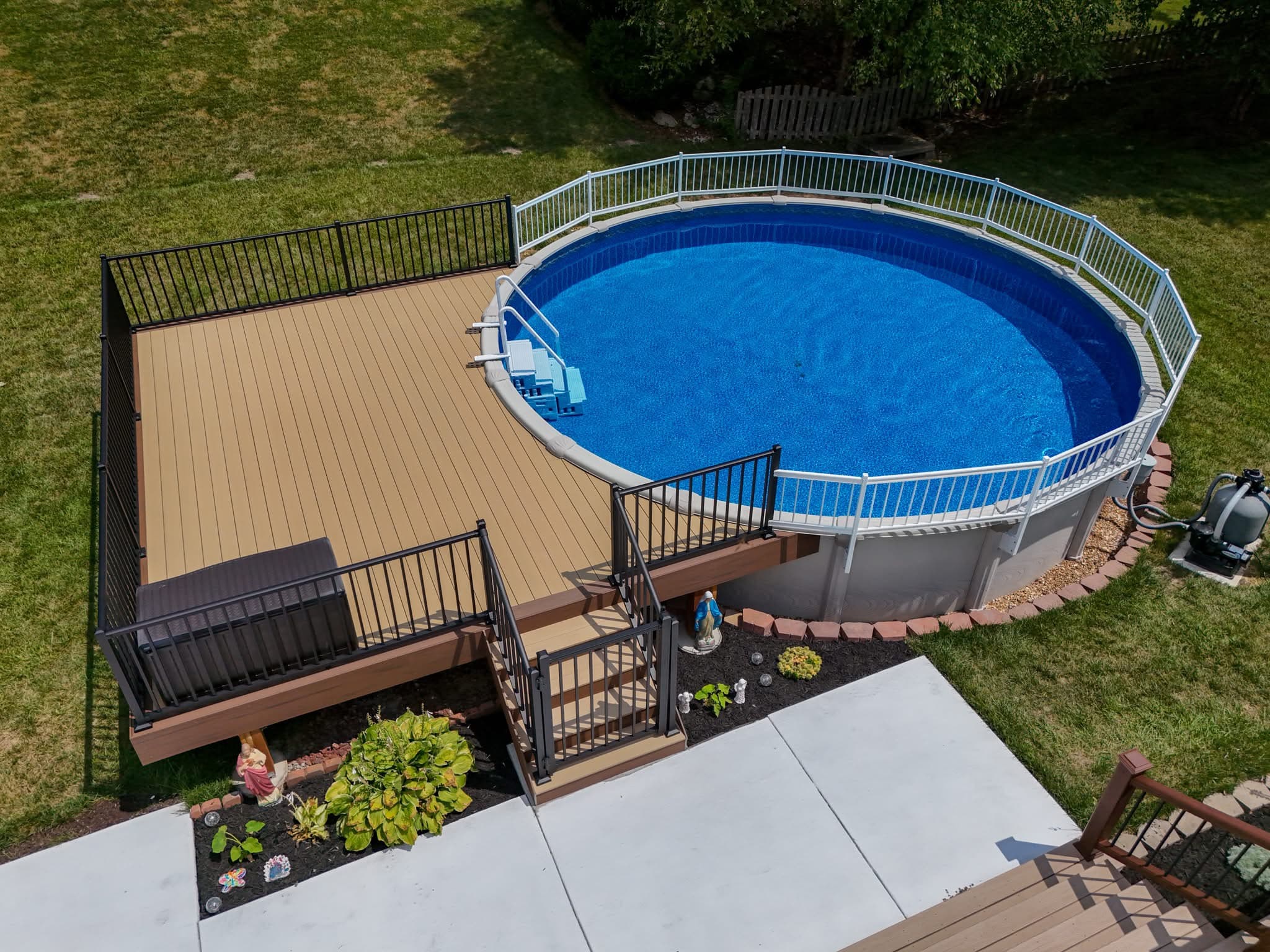
Start with heat and grip, not looks
Around a pool, two properties outrank appearance: how hot the surface gets in full sun, and how much grip it has when it is soaking wet. Get those wrong and you have built something nobody wants to stand on in July.
Heat underfoot
How hot a deck gets in full sun comes down to two things: what the board is made of, and what color it is. On material, the gap is smaller than the brochures suggest. We measured 33 TimberTech boards in full sun at 90°, and our composite samples came in cooler than our Advanced PVC samples — in light colors and dark ones both. Color did far more work than material did: 32° separated the coolest board from the hottest.
TimberTech’s own claim is about heat retention rather than peak temperature: they say Advanced PVC reflects more sunlight, retains less heat and cools down quicker than composite. The material supports it — a PVC board is lighter and less dense, so there is less of it holding heat. Around a pool that may matter more than the peak reading, because nobody stands in one spot all afternoon. You are in and out of the water, in and out of shade. How fast a board sheds heat is the next thing we are measuring.
Grip when wet
TimberTech rates its Advanced PVC lines at up to 40% better slip resistance than leading competitive composites. That matches what we see: the harder polymer cap with a textured finish holds a wet foot better than a smooth board. Ask us to wet a sample down at your estimate. It takes ten seconds and tells you more than a spec sheet.
What we recommend building it out of
Around a pool, capped composite and Advanced PVC both solve the problem wood cannot: there is no exposed wood fiber at the surface. Nothing for chlorine to bleach, nothing for rot to feed on, and no splinters — not this year, not in year ten. The choice between the two comes down to how much sun your deck takes.
Advanced PVC
There is no wood flour in the board at all, so chlorine and salt have nothing to attack — and TimberTech rates these lines at up to 40% better slip resistance than leading competitive composites. On a surface that is wet most of the time anybody is standing on it, that is the property that earns its keep. TimberTech also rates it as retaining less heat and cooling down quicker than composite.
- No wood fiber anywhere in the board
- Rated to shed heat faster than composite
- Best grip when wet
- Unaffected by chlorine or salt
- The most expensive decking we install
Collections: Vintage, Landmark, Harvest, Harvest+
Capped composite
Same sealed surface and the same freedom from splinters and rot, at a lower price. It is the better fit where you want more color and texture to choose from, where you are matching an existing composite deck, or where the budget decides it.
- More color and texture options
- Lower cost per square foot
- Came in cooler than PVC in our own sun test
Collections: Legacy, Reserve, Terrain+, Terrain, Prime+, Premier+
The honest part: Advanced PVC is the most expensive decking we install. That is the whole catch, and it is better said out loud than discovered at the estimate. What the money buys is grip when the deck is soaking wet, and a board with no wood fiber in it anywhere. What it does not buy, based on our own testing rather than the brochure, is a lower peak temperature in full sun. Whether it cools off faster once it is shaded is a separate question, and a fair one — we are measuring that next. If barefoot comfort in July is the thing you care most about, the lever that actually moves it is color, not product line. If you have real afternoon shade, or the deck is big enough that the jump between the two lines changes the whole project, capped composite in a lighter color is a strong answer for meaningfully less. We price both side by side at the estimate so you are choosing with real numbers instead of a hunch.
Color matters as much as the line you pick. Dark boards get hotter in every material made — that is physics, and no product is exempt from it. If your pool deck runs wide open with no shade, we will recommend a lighter color and tell you plainly what the difference costs. All the colors in both families are on our TimberTech decking page.
Wood around a pool: we build it, we just don’t recommend it
Plenty of people want a wood pool deck, and we will build you one. We build them in pressure-treated pine and in cedar, and a well-built wood deck around a pool can look fantastic. What we will not do is let you sign without knowing what you are taking on — because wood around water is a different maintenance commitment than wood anywhere else on your property.
| What you’re taking on | Why |
|---|---|
| Splinters | Bare feet and softwood are a rough combination, and it gets worse each year as the surface weathers. Manageable with sanding and sealing — but it stays on the schedule permanently. |
| Constant moisture | Splash-out never really dries. Wood in a permanently damp environment moves, cups, and eventually rots — even treated. |
| Chlorine and salt | Both are hard on wood fiber and on fasteners. Saltwater systems are especially unforgiving of anything but stainless. |
| Upkeep | Expect to clean and re-seal more often than a deck away from the water. Skip it a couple of seasons and the boards will tell on you. |
If you want wood, this is how we build it
Either wood works, and the choice is a real one. Pressure-treated pine is the affordable option and the one most wood pool decks get built in — and it holds up against carpenter bees far better than cedar does. Cedar is the upgrade: warmer grain, natural rot resistance that earns its keep around constant splash-out, and no chemical treatment on a surface bare feet live on. It is softer, it costs more, and carpenter bees like it. We will price both and tell you which one fits how you actually use the pool.
On fasteners: cedar gets stainless. Pressure-treated gets fasteners rated for treated lumber, and stainless is available there as an upgrade — worth taking if you run a saltwater system, because salt is unforgiving of anything else.
Why we point most people toward composite or PVC
Capped composite and Advanced PVC have no exposed wood fiber at the surface. There is nothing for chlorine to bleach or for rot to feed on, and no splinters — ever. It costs more up front and buys back most of the maintenance. Around a pool that trade usually lands in favor of composite. If you would rather have the wood, say so and we will build the wood.
Water has to go somewhere
This is the part that gets skipped, and it is the part that ruins pool decks. Water comes out of that pool all day long, and if the deck traps it against the ground you get standing water, mildew, and a structure that moves.
| Requirement | How we build it |
|---|---|
| Board gapping | 1/8” to 3/16” side to side, set for the temperature the day we install. Water drains through instead of pooling on top. |
| Framing | 12” on center. Code allows 16”, and plenty of builders use it. Composite moves with temperature, and tighter joists give it less room to telegraph that into a bounce. |
Fasteners you will not feel
On a pool deck this stops being cosmetic. A proud screw head is something you step on with a wet bare foot. We use hidden fastening systems — CONCEALoc or EDGELoc clips in the board grooves — so there is nothing on the walking surface at all. Where a hidden system is not practical, Cortex plugs sit the screw below the surface and cap it with a plug cut from your own decking. Any exposed fastener near a pool is stainless or coated, never bare.
Your pool cover has to still fit
This is the one that gets missed, and it is the one you cannot fix afterward. Decide on your cover before we frame anything.
Covers depend on the relationship between the deck surface, the coping, and the water. Build the deck too high and the cover has nowhere to go — an automatic cover cannot travel or seat properly, and a safety cover cannot pull down and tension the way it is designed to. What you are left with is a tarp held down with bricks, every winter, for as long as you own the pool.
Anchors are the other half of it. Safety-cover anchors set into the deck surface and need solid backing underneath, and that is blocking we put in during framing. Adding them to a finished deck means pulling boards back up.
| What we need to know | Why it matters |
|---|---|
| Do you have a cover now? | Existing track and anchor positions set the deck height before anything else does. |
| Might you add one later? | Cheap to build clearance in now. Expensive or impossible to add once the deck is finished. |
| Automatic or safety cover? | Different requirements — track clearance versus anchor backing and strap tension. |
If you are not sure yet, say so and we will build in the clearance anyway. We would rather leave room for a cover you never buy than take the option away from you.
The barrier is not optional
Every residential pool needs a code-compliant barrier, and the requirements are specific about height, gaps, gate hardware, and self-latching. This is enforced at inspection and it is not something to improvise. We handle the deck and the barrier together so the two are designed as one thing rather than bolted together after the fact — and we pull the permits ourselves.
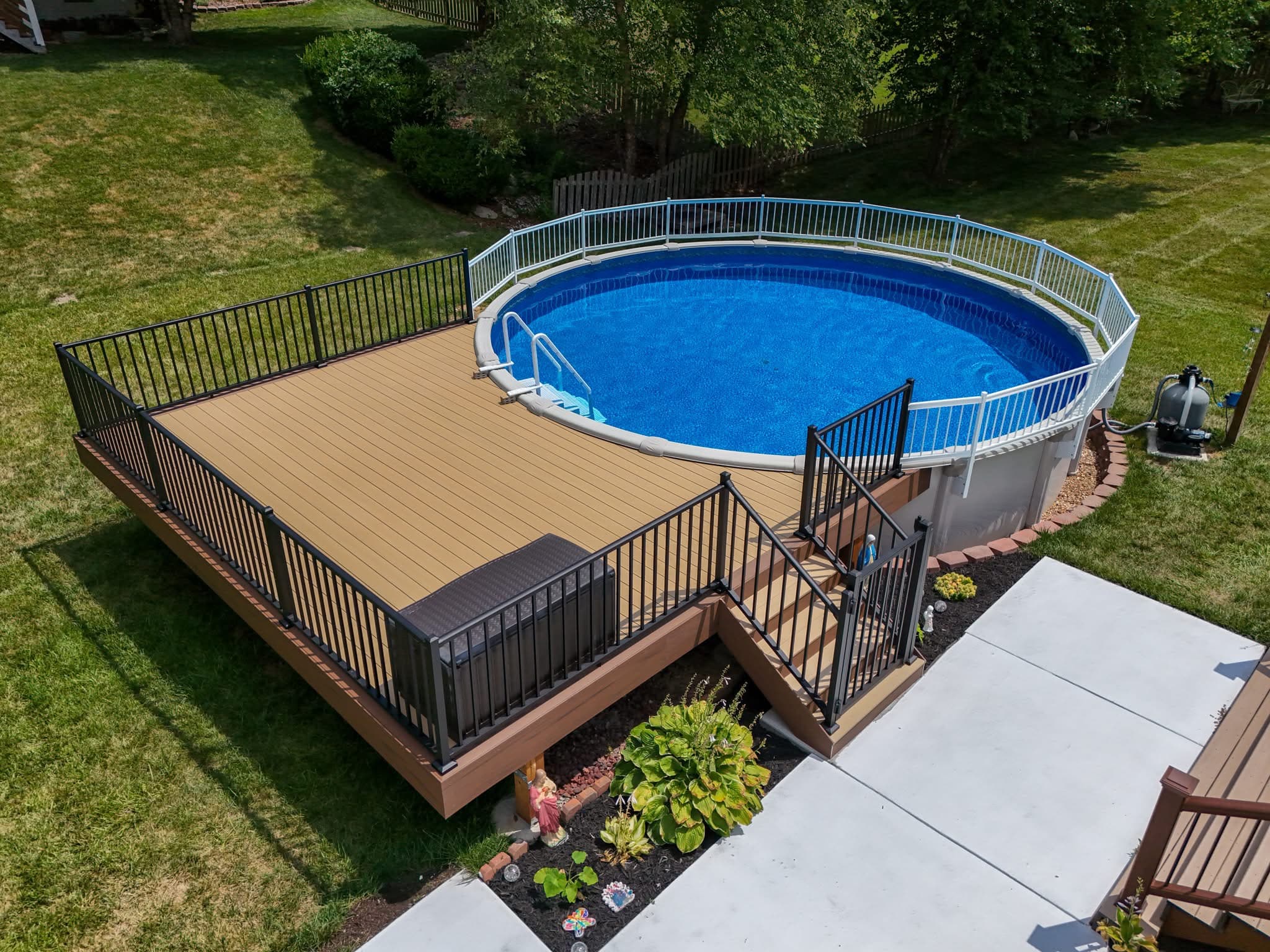
One thing worth knowing before you call anyone. If a contractor quotes your pool deck without asking about your cover, your barrier, your drainage, or whether your system is chlorine or saltwater, they are quoting square footage and nothing else. Those four answers change the material, the framing, the deck height, and the price.
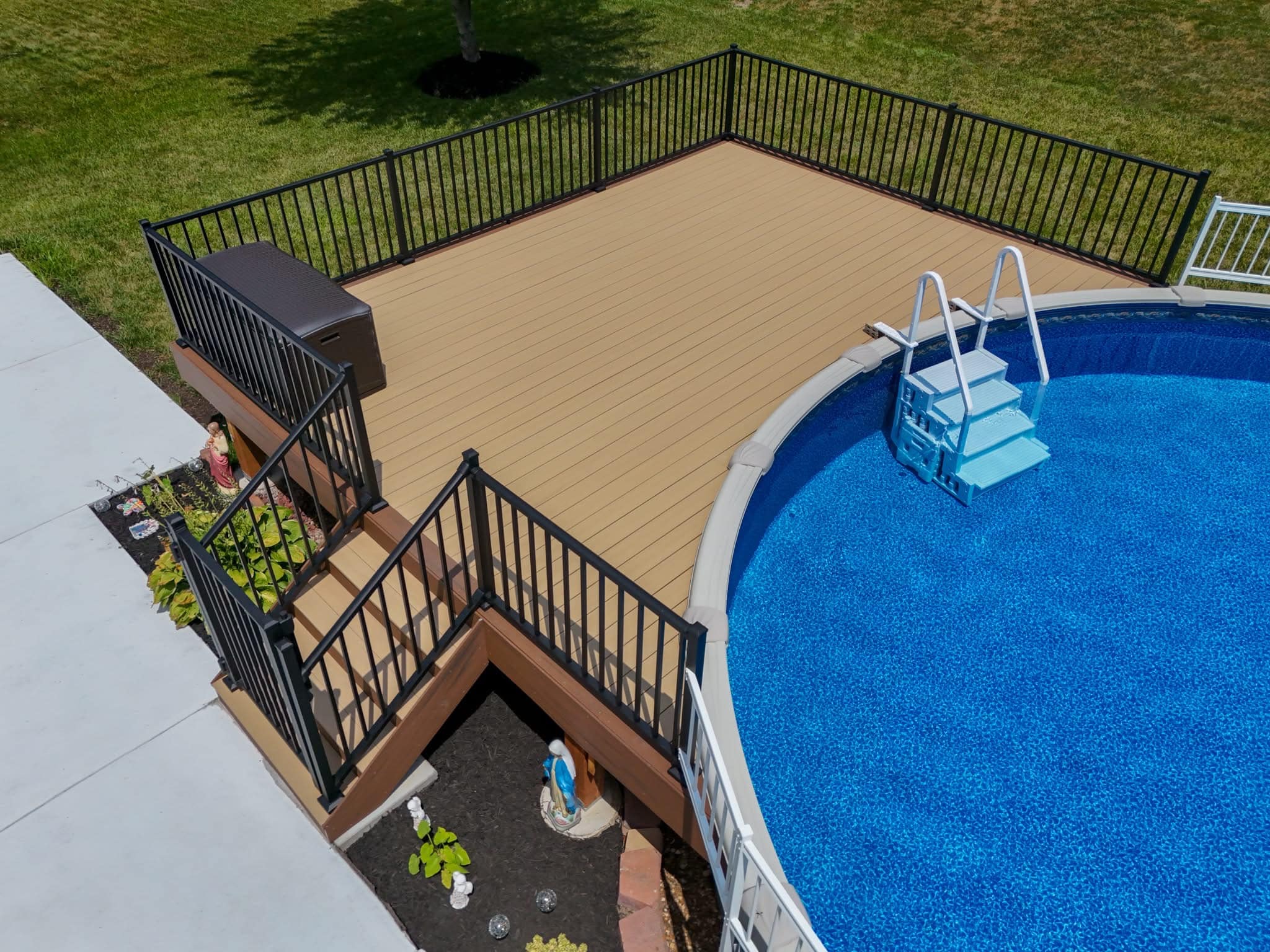

Pool codes by jurisdiction
Pool rules are not uniform across this metro. The barrier height is fairly consistent; the setbacks, the inspection list, and what counts as an acceptable gate latch are not. Below is where the actual rules live for the areas we work in most. We pull the permits and deal with the inspectors ourselves — this is here so you can read the source instead of taking anyone’s word for it.
St. Louis County
Department of Transportation & Public Works
The County publishes separate residential guides for in-ground and above-ground pools, plus a master-plan guideline covering private pools. Those guides are the documents your plan reviewer works from.
Official: In-Ground Swimming Pool guide · Above-Ground Swimming Pool guide · Private Pool Master Plans · Residential Building
City of O’Fallon
Department of Building Safety
O’Fallon publishes the most specific guidance of the four, and it is the one that speaks directly to decks:
- Every pool requires a permit before construction, and the fence is a separate permit.
- Barrier at least 48” above grade, measured on the side away from the pool, with no more than 2” clearance at the bottom.
- No opening may pass a 4” sphere. Vertical members no more than 1-3/4” apart; chain link no larger than 2-1/4” mesh.
- Gates open outward, away from the pool, self-closing and self-latching. Latch at 54” above grade, or 3” down from the top of the gate on the pool side with no opening over 1/2” within 18” of it.
- Pools, pool equipment and wood decks may not encroach into the side yard setback, and must sit 10 feet off the rear property line. Rear yard only.
- Inspections — in-ground: footing, electrical rough, bonding, final. Above-ground: electrical rough, final.
- Bonding: #8 copper tying all metallic parts, fittings, lighting, the water, and a perimeter bond loop.
Official: O’Fallon Pool Guide (PDF) · Fencing for Pools Guide (PDF) · Building & Permits
City of St. Peters
Adopts the ISPSC, 2021 edition
- Barrier top at least 48” above grade.
- An above-ground pool wall can serve as the barrier where the wall is at least 48” above grade for the entire perimeter.
- Openings may not pass a 4” sphere.
- Where a ladder or steps are the access, the release mechanism sits 54” above the walking surface.
Official: St. Peters Swimming Pool and Spa Code · Building Guides · Fence Guide (PDF)
St. Charles County
2021 St. Charles County Swimming Pool and Spa Code
The County adopts its own 2021 Swimming Pool and Spa Code, based on the ISPSC. The ordinance article online covers the administrative side — permits, the code official, appeals, penalties — while the full technical code is the copy on file with the County Registrar. If your property is in unincorporated St. Charles County rather than inside a city, this is the one that governs.
Official: Swimming Pool and Spa Code (Article XII) · Building & Construction Codes · Permits
Compiled from the jurisdictions’ own published documents and verified in July 2026. Codes get amended and guides get reissued — the building department having jurisdiction over your address always has the final say, and that is the office we deal with on your behalf.
See the materials wet, in your own yard
We bring the full TimberTech sample kit to every estimate — every collection, every color. We will hose one down so you can feel the grip, and price the lines side by side so you can see exactly what the jump between them buys.