



Summer on a Composite Deck
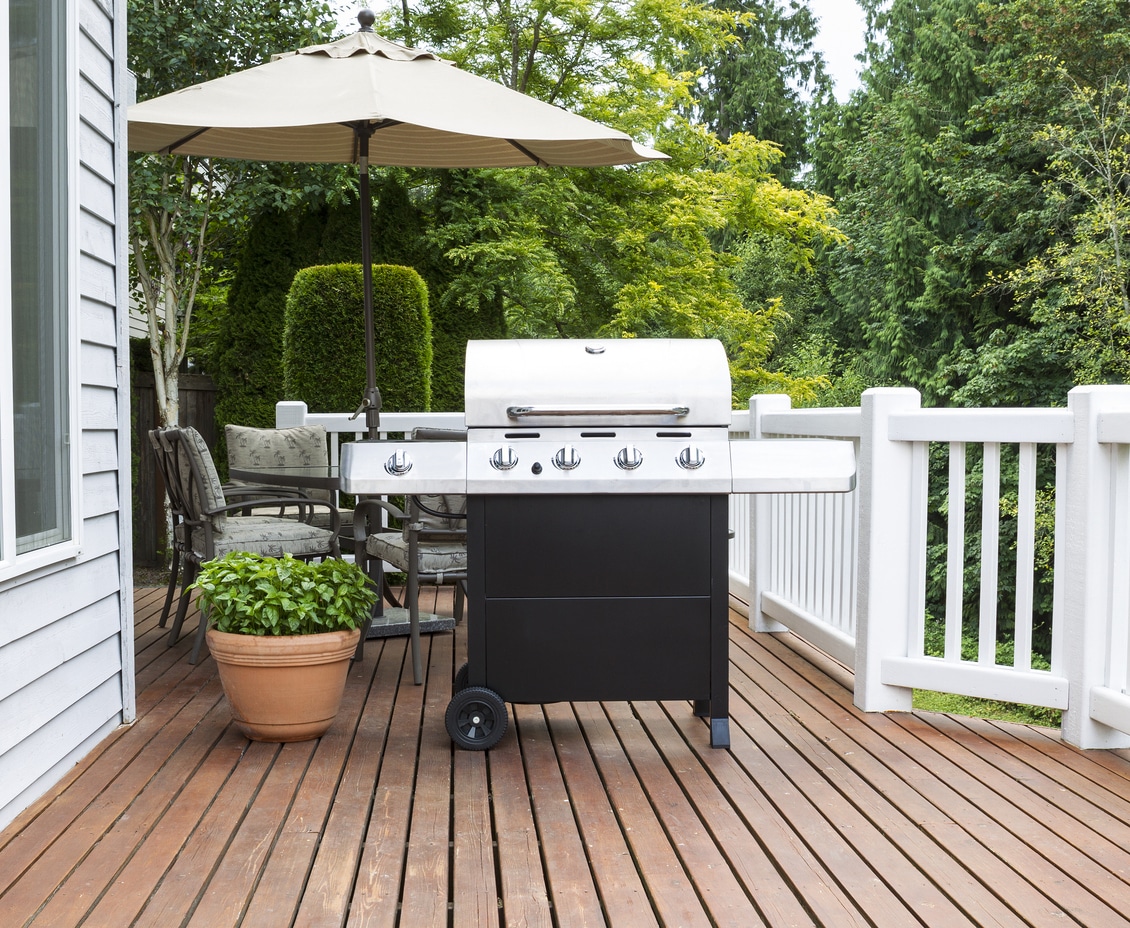
Composite decking solves the maintenance problem. It does not repeal physics. In a St. Louis July, a dark composite deck in full sun gets hot enough that nobody wants to cross it barefoot — and that is the most common complaint we hear from people who otherwise love their deck. Here is what actually helps, plus the two mistakes that cost homeowners real money.
Why it gets hot, and what actually changes it
Every decking material on the market absorbs solar heat, and darker colors absorb more of it. No product is exempt. What differs is the starting point — though not the way the brochures put it. We measured 33 TimberTech boards laid out in full sun at 90°, and our composite samples came in cooler than our Advanced PVC samples, in light colors and dark ones both. Color did far more work than material did: 32° separated the coolest board we measured from the hottest.
TimberTech’s own claim is about heat retention more than peak temperature. They say Advanced PVC reflects more sunlight, retains less heat and cools down quicker than composite, and the material supports it: a PVC board is lighter and less dense, so there is less of it holding heat. How hot a board gets and how long it stays hot are two different questions, and our test only answered the first. The second one is next.
If your deck is going in wide open with no shade, that is worth knowing before you pick a color, not after. If the deck is already built, you have three levers — shade it, cover it, or work around the hottest part of the day.
The rug trick, and the backing that ruins decks
Most of our customers land on the same answer, and it is a good one: an outdoor rug. A bamboo or woven rug over the main seating and traffic area drops the surface temperature underfoot enough to make the deck usable at midday. It is inexpensive, it is reversible, and it works better than anything else you can do to a finished deck.
The part that catches people out is the backing. TimberTech’s own care guide is explicit: avoid rubber-backed mats and rugs, because they can contain chemicals and plasticizers that may cause discoloration to the decking surface. That is not a stain you scrub out — it is the plasticizer reacting with the cap. The cheap rubber-backed outdoor rug from the big-box store can permanently mark the deck you just paid for.
- Choose bamboo, polypropylene, or another breathable woven rug with no rubber or vinyl backing.
- Pick it up now and then. Anything that sits in one spot all season traps moisture underneath and can leave a shadow.
- Same rule for tarps and pool floats — TimberTech specifically says not to leave them lying on the deck for extended periods.
Grilling on composite: use a mat, and use the right one
You can absolutely grill on a composite deck. Plenty of our customers do. But two things will permanently damage the surface, and neither is covered the way people assume.
Grease
TimberTech’s stain warranty does cover typical food and drink, grease included — but only if it is cleaned up within one week. Splatter that sits out through a summer is not a warranty claim. It is a stain you own.
Heat — this is the serious one
Radiant heat off the underside of a grill, a dropped ember, a tipped chimney starter, or hot debris can mark, deform, or burn a board outright. TimberTech’s warranty specifically excludes damage from extreme heat. There is no claim to file. You replace the board at your own cost, and matching a board that has weathered a few seasons is its own headache.
A mat under and in front of the grill solves both problems at once: it catches the grease, and it puts a barrier between radiant heat and your decking.
The trap nobody warns you about. A lot of grill mats sold for decks are rubber or vinyl backed — the exact thing TimberTech tells you to keep off the surface. You can buy a mat to protect your deck and stain the deck with the mat. Look for one described as non-staining or non-rubber-backed and rated for composite decking, and lift it after cook-outs so the deck underneath can dry out.
Everything else that helps
| What to do | Why it works |
|---|---|
| Pick the color for the exposure | The single biggest lever, and it only exists before you build. Wide open and south or west facing? Go lighter, and look at Advanced PVC. |
| Add shade | A pergola, an awning, a cantilever umbrella, or a well-placed tree. Shade beats every other fix because it stops the heat from landing. |
| Rug the traffic path | You do not have to cover the whole deck — just the route from the door to the seating. |
| Hose it down | A quick rinse cools the surface fast. It is temporary, but it buys you an evening. |
| Check for reflected sun | Energy-efficient windows can bounce and concentrate sunlight onto one spot. If a single area of your deck runs far hotter or looks discolored while the rest is fine, that is a known cause worth ruling out. |
Worth saying plainly: none of this is a knock on composite. A wood deck in the same sun gets hot too, and then splinters and needs sealing on top of it. The difference is that with composite, the heat is the one thing you have to plan around — and it is entirely solvable with a color choice, some shade, and a rug that does not have rubber on the back of it.
What we recommend
We get asked constantly, so here is what we would put on our own decks. The important thing to understand first: grease and heat are two different problems, and they take two different products. Most advice on this treats them as one.
A fiber cement grill pad
For heat and sparks
The one to buy if you only buy one. Fiber cement is inert — there is nothing in it to leach into the cap the way a rubber or vinyl backing can. Look for a pad about a quarter inch thick, roughly 30” round or 30” × 42”, and rated for composite decking. Expect somewhere around $40. Keep the recommended clearance between the pad and your heat source — usually about 24 inches.
A non-woven splatter mat
For grease
Thin, absorbent, washable, and made of non-woven polypropylene rather than anything rubberized — the good ones state plainly that they will not bond or adhere to composite decking. Put it in front of the grill where the drips land. It is not a heat barrier. Do not let anyone sell you one as a substitute for the pad.
A reversible flat-weave outdoor rug, or outdoor-rated bamboo
For heat underfoot
A genuinely reversible recycled-polypropylene flat weave is the safest choice there is, because a reversible rug has no backing at all by construction. Hose it off and put it back. Bamboo works too — it is where most of our customers land, and it does cut the heat noticeably. Just spec it properly: outdoor-rated, cotton-bound, and no rubber or PVC backing. Plenty of bamboo rugs sold for indoor use have a soy or felt backing, which is not what you want sitting on a deck through a St. Louis summer.
What to avoid, regardless of brand:
- Anything with a rubber, latex, vinyl, or PVC backing. This is the one TimberTech names specifically.
- The cheap silicone-and-fiberglass “BBQ floor mats” sold all over the internet for under grills. A lot of them are rubberized on the underside, which makes them the exact product you were trying to avoid.
- Leaving any of it down all season. Whatever you use, pick it up now and then and let the deck underneath dry and see some sun.
Planning a deck? Let’s talk about sun before we talk about color
We bring the full TimberTech sample kit to every estimate. Tell us which way the deck faces and how much shade you have, and we will steer the color accordingly — and tell you honestly whether the jump to Advanced PVC is worth it for your yard.