



How to Make Your New Deck Last 30 Years
A deck is a $30,000 to $50,000 investment sitting outside in Missouri weather. Built right and cared for, it lasts decades. Neglected, it can be in trouble in under ten years — and the difference comes down to a handful of things, none of them complicated.
Why this matters more than it sounds
The damage that ends decks early happens where nobody looks.
Most deck care advice is about the surface — the part you walk on and can see. The real risk is underneath.
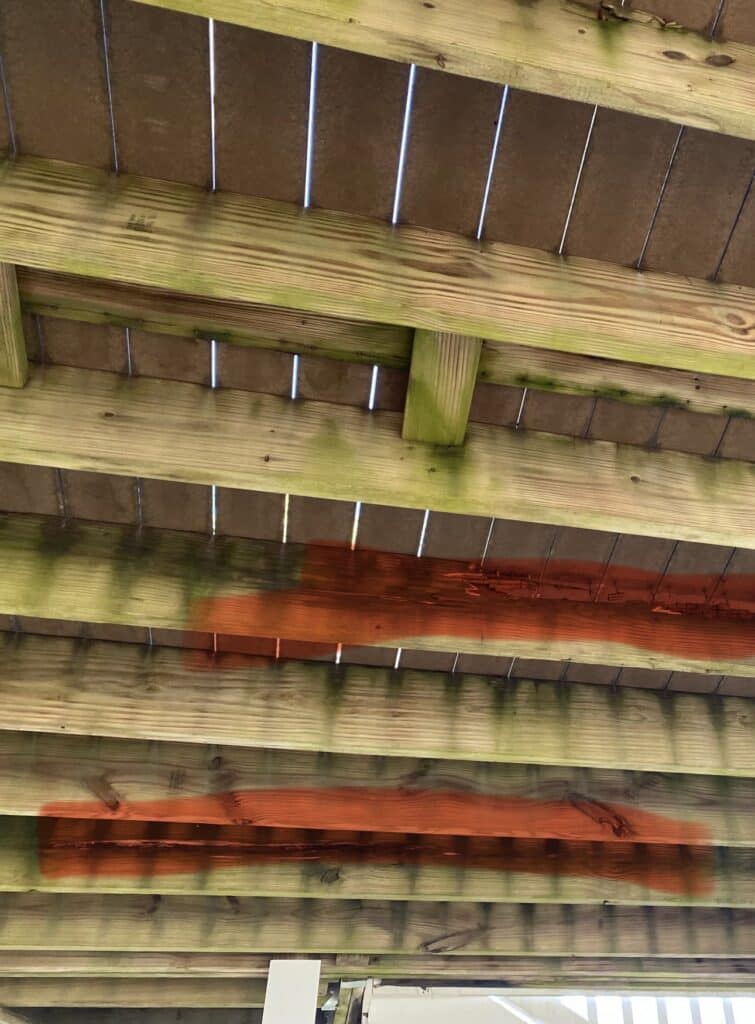
White and black mold grows on the framing under a deck — in the shade, out of sight, where nobody thinks to look. It feeds on the wood and it works quietly. A deck that should have given you 25 to 30 years can be structurally finished in about 10. That is a real disappointment, and it is painful on the pocket.
We build with a special red stained lumber that has been treated to better protect against this kind of mold, and it does help. But the odds are never zero — no treatment prevents it one hundred percent of the time. What actually keeps it in check is the yearly wash and keeping the underside clear of trapped debris and moisture.
That is the whole argument for maintenance. It was never about appearance. It is the difference between a deck that lasts ten years and one that lasts thirty.
If your framing looks anything like the photo above, it is worth having someone who builds decks for a living put eyes on it. That is exactly what our private deck inspection is for — a written photo report, a straight safe / repair / replace call on each part of the deck, and if repairs make sense, a real number to bring it back to code.
What actually kills a deck
It isn’t storms and it isn’t bad luck.
-
Lack of maintenance is the number one cause of premature deck failure
Decks that fail early are almost always decks that never got power washed once a year and never got stained every three to five years. That is the entire pattern. It is rarely anything more dramatic than that.
-
Why power wash once a year?
Because you need to remove the organic matter growing on the deck — mold, algae, and fungus. All of it feeds on your deck to survive, and every year it does, the structure gets weaker. It looks like a cleaning job. It is actually structural.
-
Why staining matters, and why the stain you pick matters more
Stain creates a layer between the wood and the outside elements. But the product matters as much as the act. For a wood deck, use an oil-based transparent or semi-transparent stain. A thin-viscosity stain soaks fully into the wood fibers, and that saturation is what protects it. A thick film sitting on the surface is not the same thing and will not last.
-
Quality materials and correct code practices
Longevity starts before the first board goes down. Pressure treated lumber and galvanized hardware go a long way on any exterior project. Cheap fasteners in particular are a false economy — they are a tiny fraction of the cost of a deck and they are what holds it together.
-
Who builds it
The connections — ledger, hangers, guardrail posts — are where decks actually fail, and they are invisible once the decking is on. You get one chance to get them right, and no amount of maintenance later fixes a bad ledger.
A realistic yearly routine
Not a chore list. Four things, and one of them is just looking.
Our workmanship warranty. One year on pressure-treated decks and fences; three years on composite decks with aluminum railing and all other work we perform. It covers structural integrity, safety, and workmanship — not appearance, and not damage from missed maintenance. During the warranty period we’ll inspect the work once a year at your request, at no charge, and it transfers once to a new owner of the home.
If your deck is older and you are not sure what shape it is in, we do private deck inspections with a written photo report and a straight safe / repair / replace verdict on each part of it.
Where we come in
Some of this you can do yourself. The rest is what you shouldn’t have to guess at.
Power washing
Done at the pressure your decking is actually rated for — composite caps out at 1500 psi, fan tip, with the grain. We are meticulous about it and we are usually not the cheapest bid. A pressure washer in the wrong hands takes years off a deck in an afternoon.
Private deck inspection
A deck builder walks your deck, checks the ledger, footings, framing, and railings, and hands you a written photo report with a safe / repair / replace call on each part. See what’s included.
Repairs
Rotted joists and rim boards, loose guardrail posts, failing stair stringers, ledger and flashing problems. The structural things that don’t fix themselves and get more expensive every season.
Rebuild
Sometimes the honest answer is that the money is better spent on a new deck than on patching an old one. We’ll tell you which situation you’re in, and price both if you want to compare.
And if we built your deck: your annual inspection is free for the length of your warranty. Just ask. We would rather find a loose rail post than hear about it later.
Questions about your deck?
Whether we built it or not, we’re happy to tell you what we see.